
Piute Sheriff Has No Jail
Official UDC jail-program material reports zero jail beds in Piute County. It says people sentenced to serve Piute jail terms are transported to Sevier County Jail. The finding rules out a local jail roster, release desk, mugshot archive, and 24-hour or 72-hour Piute jail feed. The sheriff's official page has contact information, but no inmate-search or released-person link.
The statement about sentenced people should not be stretched to every arrest. Pretrial placement, temporary holds, juveniles, and later transports can follow another route. Operational arrangements may also change. For one person, ask which facility accepted the booking. The housing facility, not the county name on the criminal case, holds the physical release record.
Find a Piute Arrest Custodian
Call the Piute County Sheriff's Office with the person's full name, date of birth, arrest or citation date, and case number if known. Ask where the person was booked and whether Piute transported the person again. Do not ask only whether the person is “there,” because the office has no jail population to search.
- Confirm the event was a Piute arrest or transport.
- Ask for the name of the jail or agency that accepted custody.
- Check that facility's current-custody source, if one exists.
- Ask the facility whether departure was community release or transfer.
- Request the Piute transport record and the housing jail's release entry when documentary proof matters.
The Piute County released inmates search path explains how to connect those records to the court case, UDC, VINE, or a receiving federal agency. A live jail roster can answer where someone is now. It cannot by itself reconstruct a past release.
Piute Arrest and Transport Records
Piute likely maintains the incident, arrest, and transport material its officers created. A focused Utah GRAMA request should identify the person and incident, then ask for existing records rather than a new explanation. Useful identifiers include full name and aliases, date of birth, arrest date, arresting officer or agency when known, citation or case number, and destination facility.
The housing jail maintains different facts: admission time, booking number, custody movements, release or transfer timestamp, release authority, and receiving agency if recorded. Asking Piute for a Sevier jail-door time risks delay because Piute may not maintain it. Asking Sevier for Piute's incident narrative creates the reverse problem. Split the request by who created each record.
| Question | Likely custodian |
|---|---|
| Why and when was the person arrested? | Piute County Sheriff's Office |
| Where did Piute transport the person? | Piute County Sheriff's Office |
| When did jail custody end? | Actual housing jail |
| What court order authorized release? | Piute district or justice court |
| Did state custody continue? | UDC and Utah Board records |
Contact Piute Sheriff Records
The official Piute County Sheriff page identifies Sheriff Marty Gleave and provides the office contacts below. No dedicated online GRAMA portal, published records hours, fixed fee schedule, sheriff app, or release feed was found. Ask how to submit a written request and who currently serves as records officer.
Piute County Sheriff's Office550 N. Main
Junction, UT 84740
435-577-2893
Fallback: 435-577-2972
Fax: 435-577-2894
The official page also shows why a visitor should not expect a local inmate-search menu.
Piute County's sheriff page is the source for the agency identity and contact route.
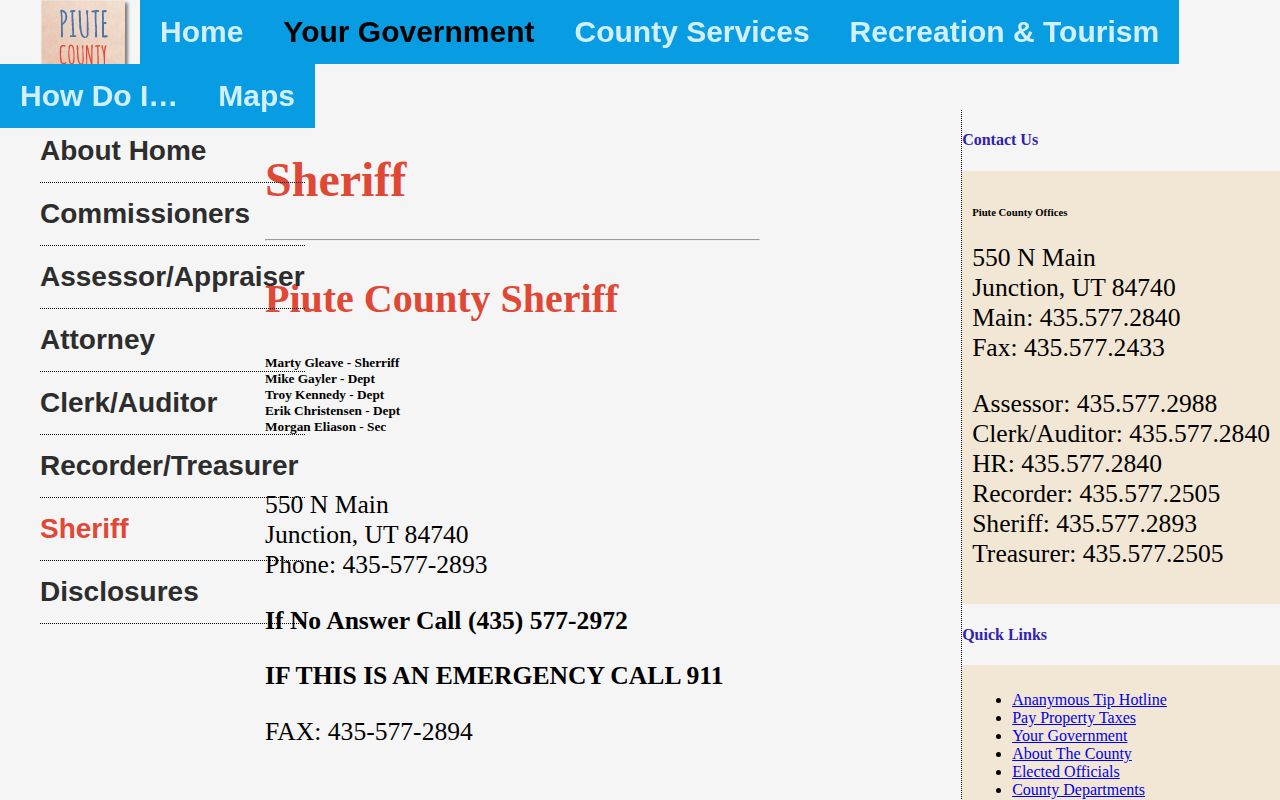
The image confirms the local starting point, while the holding jail still supplies the physical release or transfer evidence.
Where Piute Detainees Go
Sevier County Jail is the principal serving jail for sentenced Piute cases. Its current inmate search can help establish present custody, but it is not a released archive. If a name disappears, call Sevier and ask for the actual event. Community release, court-ordered release, bond, sentence completion, and transfer are different outcomes.
Garfield County Jail appears in a 1998 county plan as an emergency-service connection. That old reference is not current proof that a Piute detainee went to Panguitch. Use Garfield only when Piute Sheriff, the court record, or another official source identifies it for the person. If UDC accepted custody after a felony commitment, move to the statewide offender search and Board record rather than continuing to search county rosters.
Piute Release and Court Authority
The Sixth District Court location in Junction handles felony and class A matters. Justice court generally handles lower misdemeanors, infractions, and traffic cases. Search both jurisdictions if the charge level is unknown. The docket may show bail, recognizance, dismissal, sentence, probation, commitment, warrant recall, or another order that explains why custody changed.
A court order does not always equal immediate physical release. Processing may take time, and another warrant, hold, or commitment can prevent a person from leaving confinement. Pair the order with the housing jail's timestamp and destination. Conversely, a jail entry can show departure without fully explaining the legal result. The two records answer different questions.
- Release
- Physical custody ends under an identified legal authority.
- Transfer
- Custody moves to another agency and continues.
- Commitment
- A court directs custody under a sentence or order.
- Discharge
- A sentence or supervision term ends, which is broader than leaving one building.
Note: A scheduled court appearance, future date, or roster absence should never be reported as the completed physical release event.
Piute's No-Jail History
The lack of a Piute jail is not a recent web-site omission. It is an institutional fact documented by current state material. Historical references can still create confusion. A Garfield County plan from 1998 described emergency service for Piute, while later UDC material identifies Sevier for sentenced Piute offenders. Neither document proves the placement of a specific person without a current agency record.
This history makes the custodian question the heart of every Piute release inquiry. County of arrest, county of conviction, housing jail, release building, and supervision office may all be different places. A state prisoner connected to Piute may leave through Salt Lake City and report to Richfield. A county detainee may leave Sevier. Accurate language should name the event and the agency, not collapse all of them into a fictional “Piute County Jail release.”
Request a Piute Release Trail
Under Utah GRAMA, ask for the minimum existing records that show the trail. From Piute, request arrest and transport records, including the destination if maintained. From the jail, request booking, movement, and release or transfer fields. From the court, obtain the disposition or order. If a record is partly restricted, request the segregable public part and the legal classification for any withholding.
No flat local fee or certain response date was verified. Ask for an estimate before charges are incurred. The request should not demand that staff create a new report or decide what the law meant. Existing timestamps, agency names, and order references are the clearest path to verification and preserve the crucial distinction between release and transfer.
Match Piute Release Identifiers
A reliable trail must connect the same person across agencies without relying on a name alone. Record the full name and aliases, date of birth, arrest date, citation or Piute case number, booking number, and UDC number when one exists. Use only the identifiers needed for the request. The Piute transport destination and the accepting jail's booking number create the most useful bridge between the two custodians.
Dates should also be labeled by event. Arrest, jail admission, court order, release processing, physical departure, parole, and discharge may occur at different times. When an agency supplies a timestamp, preserve its field name. Do not relabel a transport time as release or a court filing time as the jail-door event. If the jail identifies a receiving authority, follow that system until an actual community release or final discharge is documented.
VINE can serve as an alert channel for a participating Utah jail or state prison, but its result is not a certified historic record. UDC instructs users to confirm important events, and the Board has warned of possible missing or inaccurate notices. For a Piute county-jail event, verification returns to the actual jail. For a prison parole, it goes to UDC and the Board.
The same restraint applies to old records. Public court results can disappear after sealing or expungement, and older electronic coverage may be incomplete. A blank search does not prove that an arrest or release never occurred. Contact the proper clerk or record custodian and respect any access restriction instead of reconstructing a personal history from unofficial copies.