
Piute County Release Date Types
A projected, scheduled, or tentative date describes a possible future event. An actual release date records a completed movement. Those ideas must remain separate in a Piute County case. A court may order release, yet another hold can keep the person in custody. The Utah Board of Pardons and Parole may grant a parole date, then review or rescind it before departure. A transfer from Sevier County Jail to UDC, ICE, another county, or federal custody is continued custody rather than community release.
Pretrial detention has no sentence end date. The court may change bail, impose conditions, dismiss a case, or enter a later order. A definite county jail sentence can be computed from the commitment, credit for time served, lawful jail credit, discipline, and holds. Utah state prison terms are generally indeterminate, which means the judgment sets a statutory range and the Board may authorize parole before the maximum expires.
Find Piute County Release Dates
Piute County has no jail. The first step is therefore not a Piute roster search. Ask the Piute County Sheriff's Office which facility accepted the booking. Official UDC material says sentenced Piute jail offenders go to Sevier County Jail, but it does not establish that every arrestee or temporary hold always follows that route. Once the custodian is known, match the record path to the legal status.
- Obtain the court case and read the latest judgment, bail order, sentence, or commitment.
- Decide whether the person is pretrial, serving a county jail term, or serving a UDC prison sentence.
- For a Sevier jail term, ask the jail for its recorded computation and any release or transfer entry.
- For a state term, search UDC and the Board's final decisions for the agency's own date labels.
- Check for a later rescission, court change, warrant, detainer, or receiving agency.
- Confirm the actual departure with the agency that physically held the person.
The Piute County released inmate records workflow adds the court, VINE, and records-request steps when a name has already left a live custody list. An absence alone does not answer when or why the person left.
UDC Piute County Release Dates
The UDC Offender Search covers people currently incarcerated or currently supervised on parole or felony probation. Search by UDC number when possible. Otherwise, enter at least one letter of the first and last names, then compare date of birth, legal status, offense, sentencing court, case, and location. The locator is not a historic list of all discharged people.
UDC's public-information terminology is important. Its record sources identify a Parole/Expiration Date, not a universal field promised as “projected release date.” Public offender information can also include legal status, UDC number, facility placement, sentence data, Board hearing date, commitment, and sentencing court information. The exact subset on a live result may differ. For a fully discharged person who no longer appears, request the existing parole, termination, expiration, or discharge date through the UDC public-information and GRAMA route.
The current-supervision limit and search fields are shown on the official UDC source below.
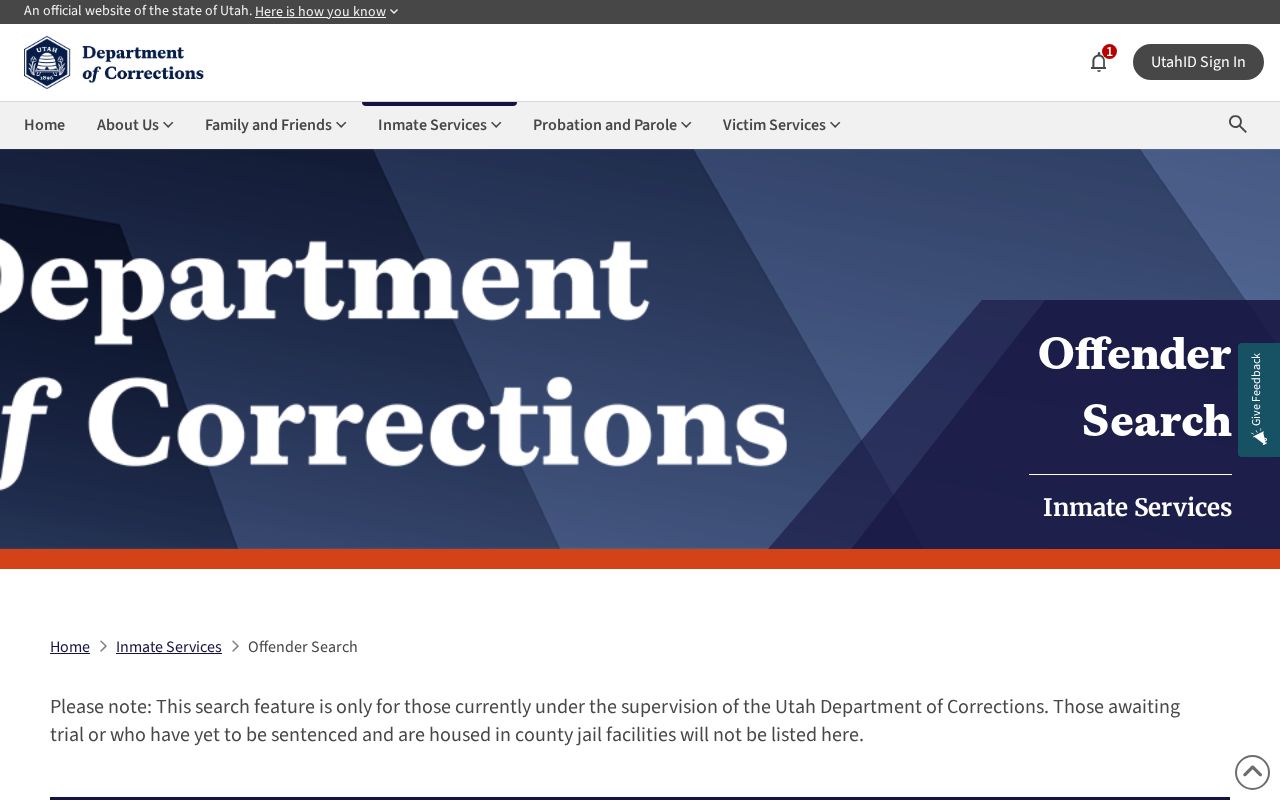
A “parolee” result means the person has left prison but remains under Board conditions and AP&P supervision. A prison-facility result means custody continues, even if a future date appears.
Note: Preserve UDC's exact date label in any record because parole, expiration, termination, and discharge describe different legal events.
Board Dates for Piute County
Utah separates the prison judgment from the release decision. Under Utah Code §77-18-111, a prison sentence generally runs between a statutory minimum and maximum unless the Board terminates or commutes it sooner. The Board can schedule an original hearing, set a parole date, order a rehearing or review, or enter another decision. A tentative hearing month is not a parole promise.
The Board's materials use several distinct labels. A guideline date helps decision-making but creates no entitlement. A tentative hearing date is an estimated period. An actual hearing can lead to a published order, but even a granted parole date may carry conditions. A rescission process can remove that date before physical release because of conduct, a new conviction, or another issue.
Original-hearing scheduling begins after prison admission. Board guidance says the tentative month and year are set within the first six months and may reflect the guideline date, presentence report, offense, treatment needs, and submitted material. The actual day and time are scheduled only a few weeks before that period and can change because of pending reports, another proceeding, or available capacity. Search again near the expected month instead of treating the first estimate as final.
| Date or status | Meaning | Best confirmation |
|---|---|---|
| Tentative hearing | An estimated Board scheduling period | Board hearing search near the period |
| Guideline date | A decision aid, not a right to release | Later Board order |
| Parole date | A Board-authorized release date subject to later events | Final order plus UDC confirmation |
| Expiration date | The sentence endpoint shown in UDC information | UDC public offender record |
| Discharge or termination | The end of corrections jurisdiction | UDC or Board record |
Search the Board hearing and decision system by name or offender number. Then look for a newer order. A hearing without a posted decision proves neither release nor denial.
Piute County Release Date Credits
Utah has no researched rule that makes every state prisoner serve a flat eighty-five percent. Federal shorthand must not be imported into a Utah calculation. State sentences, Board authority, offense-specific limits, earned-time rules, and the actual order all matter. Under Utah Code §77-27-5.4, earned time can affect the Board path when an eligible person completes an approved program. The Board glossary describes an adjustment of up to four months earlier, but eligibility, approval, forfeiture, contingencies, and a Board action control. No one should simply subtract four months from a web date.
For a definite local jail term, Utah Code §76-3-403 is the starting point for good-behavior credit. The real computation can also depend on the written sentence, credit for time served, jail administration, discipline, lawful work or program credit, later court orders, and other holds. No public Sevier-specific calculation policy or weekend-release rule was verified. Ask the jail for its existing computation rather than building one from the arrest date.
Note: Utah earned time and jail good behavior are separate rules and should never be blended into one Piute County release formula.
Why Piute County Dates Change
A date can move for legal, administrative, or custodial reasons. Some changes shorten a path to release. Others delay it or turn an expected community release into a transfer. The latest official event controls.
| Factor | Possible effect | Record to check |
|---|---|---|
| Credit for time served | Changes the remaining local term | Judgment and jail computation |
| Good behavior or earned time | May support an earlier date when lawful | Jail record or Board order |
| Discipline or forfeiture | Can remove or alter credit | Custodian or Board record |
| Parole grant or rescission | Can set or withdraw a state release date | Newest Board order |
| Court order | Can change bail, sentence, credit, or custody | Piute court docket |
| Detainer or other hold | Can prevent community release or cause transfer | Jail and receiving-agency records |
A current roster disappearance remains ambiguous. It can mean community release, UDC transport, another county, ICE, a federal writ, or a search mismatch. Ask Sevier for the destination and timestamp. If UDC took custody, switch to UDC and Board records. If another authority took the person, follow that system.
Piute court records add the legal reason. Sixth District Court handles felonies and class A misdemeanors, while the justice court generally handles lower misdemeanors, infractions, and traffic matters. Search both when the charge level is not known. A docket can show bail, dismissal, judgment, a jail commitment, UDC commitment, credit for time served, probation, or a later warrant. The court explains authority, but the jail still records the door time and transfer destination.
Utah Prison Release Day
UDC's Release Day instructions create a distinctive state-prison path for Piute cases that reach UDC. The department says parole and release processing occurs on Tuesdays and that almost everyone, including most state prisoners housed in county jails, processes through Utah State Correctional Facility. People coming from USCF or Central Utah Correctional Facility have separate arrival guidance from those housed in county placements. Rare county-jail release exceptions are communicated to the affected person or family.
Physical prison location can therefore mislead. A UDC inmate housed at Sevier under the Inmate Placement Program may move to USCF before community release. A CUCF prisoner also generally travels to USCF for processing. UDC says people without rides may be taken to a nearby UTA TRAX station and are released last, while people paroling to a community correctional center are transported by the department.
None of these Tuesday procedures governs an ordinary Sevier county-jail release. A Piute misdemeanor detainee follows the court and jail process, not UDC Release Day. Establish legal custody before using state travel details or arrival guidance.
Note: UDC arrival and transit guidance applies to state-prison processing, never as a promised pickup time for an ordinary Sevier release.
Confirm Piute County Release Dates
Final confirmation should pair legal authority with physical movement. For a local term, compare the Piute judgment with Sevier's release or transfer entry. For a state sentence, compare the latest Board order with UDC's parole, expiration, or discharge information. If advance notice would help, the Piute County VINELink release check explains how to register and why the resulting alert still needs agency confirmation.
A fully discharged person may no longer appear in UDC's current-supervision search. In that case, use UDC's public-information request route and ask for the existing legal status plus the parole, expiration, termination, or discharge date. Include the UDC number and Piute court case when known. A no-result may also reflect a county-only sentence or a spelling mismatch, so it is never a discharge certificate.
Ask for exact existing fields: admission time, release or transfer time, release authority, and receiving agency if maintained. A focused GRAMA request is stronger than asking an office to calculate when someone should have left. If the date affects travel, a court step, or personal safety, verify it again close to the event.
Does a parole date prove release? No. It records an authorized date subject to later Board action, holds, and processing. The physical custodian confirms departure.